

[ad_1]
We really are making ourselves at home in space, with junk, rovers, plans for construction… and now, advertisements.
Last month, the 13-ft-tall, six-legged Odysseus lander became the first American spacecraft on the moon in more than 50 years. And the first private vessel to make a successful lunar landing in human history. Launched by the space company Intuitive Machines, it had a turbulent landing, lost a leg, almost lost its way, and survived only a week. But in that time, it beamed back some vivid selfies with the Earth and moonscapes as the backdrop.
Zoom in a little and one can see a logo for Columbia Sportswear on the lander, part of a marketing deal with that brand that supplied the insulating material for its propulsion tank.
That isn’t even the first commercial advertisement on the moon. When the Japanese space exploration company Ispace crashed its lander, Hakuto-R, into the lunar surface in April, on it were the logos of Japan Airlines, Suzuki Motor Corp and Mitsui Sumitomo Insurance, among others.
Meanwhile, Sent Into Space, which calls itself “the world’s first marketing-focused space agency”, has already sent a BlendJet smoothie-maker, a bottle of Heinz ketchup, Mattel’s Astronaut Barbie, and a single chicken nugget made by frozen-foods brand Iceland, among other products, into the upper stratosphere, attached to high-altitude balloons, as part of social-media-focused promotional campaigns.
Before the private space race, brand visibility in space typically consisted of small logos of collaborators on spacecraft and spacesuits. There were a few exceptions. Pepsi and Coca-Cola pulled off some early product placement with a space-friendly can in 1985. Russian astronauts filmed a milk commercial for the Israeli brand Tnuva Dairy in 1996, which holds the Guinness record for first advertisement shot in space.
Once the International Space Station opened up to commercial activity in 2019, promotional campaigns began to appear in the form of educational outreach and scientific experiments (including some by Mattel, featuring Barbie dolls; some by Adidas, linked to experiments in shoe design).
Now, in a time of incessant clamour here on Earth, advertisers are ratcheting up the volume on two new fronts. Space is one. Surrealism is another.
Pie in the sky

Surrealist advertising is a sub-genre that hinges on computer-generated imagery (CGI) designed to make it look as if products have taken over landmarks in the real world.
In this manner, brightly coloured Jacquemus handbags have zipped through the streets of Paris, in an online ad. A dollop of toothpaste seemed to narrowly miss passersby outside the Isabel Marant men’s store, also in Paris.
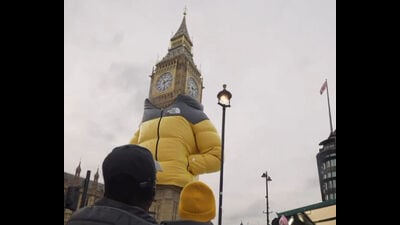
People gathered to look up at a Big Ben “clad” in a North Face puffer jacket. A single Tod’s shoe rolled down a street in Tuscany on little wheels. And, in Mumbai, large tubes of Fae lipstick lay tossed about on the street near Gateway of India.
It is hard to tell where this new race will lead. “The current use of space and surrealist advertising is a move backwards, to an age of trademark advertising when everyone flexed their brand identity through logos without focusing on messaging,” says KV Sridhar, an industry veteran and former chief creative officer at Leo Burnett India.

What does a CGI horse on a street (a surrealist Instagram campaign by the US restaurant chain PF Chang’s, to mark its debut in Mumbai), a larger-than-life mascara at a train station, or a cupcake atop a famous monument tell us about the brand’s value, Sridhar asks.
“Gimmicks can draw attention, but they won’t create relatability, which is what every brand needs in order to sustain itself in the public memory.”
That could change in the next evolution, with both space and surrealist advertising likely to embrace augmented reality and holograms (where see-through spectres of the giant bags actually do bounce past you in the real world).
In January, for instance, Hugo Boss projected a 33-ft-tall hologram of the supermodel Gisele Bündchen and South Korean actor Lee Min-ho into thin air near London’s Tower Bridge, as a part of the promotional campaign for its 2024 Spring/Summer collection. Holographic billboards could feature see-through people and animations moving around, commenting on products, listing key features.
“We can expect a virtual layer on physical reality soon and a lot of it will be advertising,” says Santosh Desai, author and CEO of the brand consultancy Futurebrands. “Ironically, our virtual spaces may become more protected as we exert more control over them, but physical spaces will bear the brunt of the onslaught of new innovation and be encroached upon.”
The Las Vegas Sphere, inaugurated in September, is an example of how advertising innovations can loom. The next step could be logos projected into the night sky, Desai says. Tech start-ups such as the Russian StartRocket have so far expressed intent but shelved their plans following a barrage of criticism.
“The pristine beauty of the hills has already been marred by huge advertising billboards,” Desai says. “The thought of not being able to look away from logos in the sky is horrifying.”
[ad_2]
Source link