
[ad_1]
March 21, 2024
EU leaders call for immediate humanitarian pause in Gaza
European Council President Charles Michel said on Thursday evening that EU leaders had agreed on a strong joint statement calling for an end to the fighting in Gaza.
“Strong and unified statement of EU leaders on the Middle East at #EUCO tonight!” he wrote on X, formerly Twitter. “The EU calls for an immediate humanitarian pause leading to a sustainable cease-fire.”
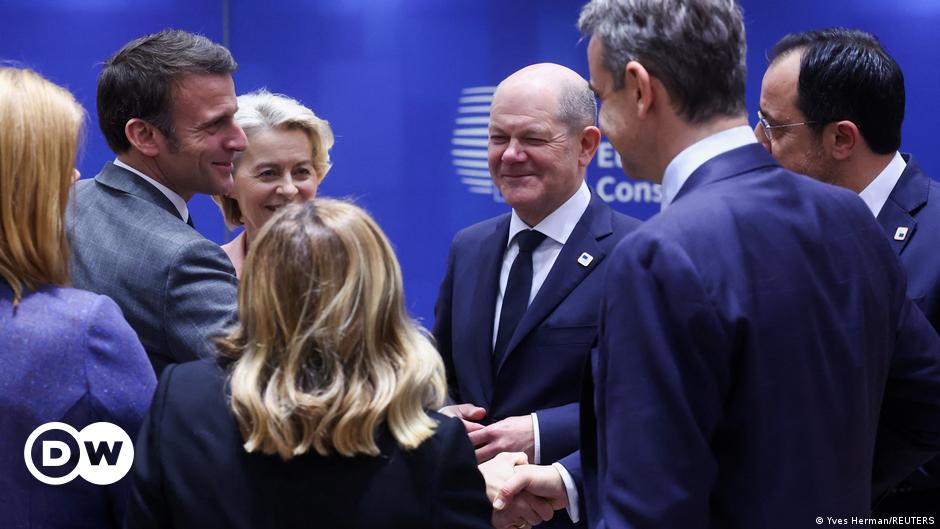
The statement came after the leaders of the EU’s 27 member states met in Brussels for a high-level summit where the war in Gaza was high on the agenda.
The conflict has divided member states with some showing greater support for Israel and others condemning the situation in Gaza. But the increasing death toll and warnings of a dire humanitarian disaster in the strip has seen the bloc push for more urgent action.
“Full & safe humanitarian access into Gaza is essential to provide the civilian population with life-saving assistance in a catastrophic situation in Gaza,” Michel wrote.
https://p.dw.com/p/4dzxN
March 21, 2024
EU opens accession talks with Bosnia and Herzegovina
European Union leaders have agreed to open membership talks with Bosnia and Herzegovina, putting the Balkan country on the same track as its neighbors in Serbia, Albania and North Macedonia.
European Council President Charles Michel made the announcement on X, formerly Twitter, saying “Your place is in our European family.”
“Today’s decision is a key step forward on your EU path. Now the hard work needs to continue so Bosnia and Herzegovina steadily advances, as your people want,” he added.
Bosnia became a candidate to join the bloc in December 2022, having applied in 2016, but was not yet in the necessary talks with Brussels that could lead to eventual accession.
https://p.dw.com/p/4dzvB
March 21, 2024
Hungary’s Orban congratulates Putin on election win
Hungarian Prime Minister Viktor Orban wrote a letter to congratulate his Russian counterpart, and friend, Vladimir Putin after an election that has been slammed by many of Hungary’s allies in the EU and NATO.
Hungarian government spokesperson Zoltan Kovacs said Orban had, in a letter to Moscow, “congratulated Vladimir Putin on his re-election, noting that the cooperation between Hungary and Russia, based on mutual respect, enables important discussions even in challenging geopolitical contexts.”
Brussels said the Russian election was held “in a highly restricted environment exacerbated also by Russia’s illegal war of aggression against Ukraine.”
Hungary has knocked heads with the rest of the bloc numerous times, often over Orban’s close relationship with Putin and his antagonism toward Ukrainian President Vlodymyr Zelenskyy.
https://p.dw.com/p/4dzio
March 21, 2024
Zelenskyy asks for more air defense systems, ammunition
Ukrainian President Volodymyr Zelenskyy urged European allies to provide Ukraine with additional air defense systems.
“The existing air defense systems are not enough to protect our entire territory from Russian terror,” he said. “It’s not a matter of hundreds of systems, but of an achievable number — to protect all the territory of Ukraine.”
He said Ukrainian air defense had managed to shoot down 31 Russian missiles after a Russian aerial onslaught on the capital, Kyiv.
Zelenskyy thanked allies for providing €5 billion as part of the Ukraine Assistance Fund and hailed a Czech-led initiative to purchase artillery shells. However, he added that “Europe can provide more” and called for EU members to supply Kyiv with more ammunition to push back Russian forces.
Ukraine’s president said the country had “once again become a donor of food security for our traditional export destinations — North Africa and Asia.” He said Europe stands to benefit from cooperation with Kyiv on trade.
He also said it was “unfair” that Russian and Belarusian products were still being transported into Europe and urged against “trade separatism” that seeks to put tariffs on Ukrainian goods.
The Ukrainian leader pushed for a start to “real negotiations on Ukraine’s accession” to the European Union.
“Ukrainians need to see the EU getting closer,” he said.
Speaking on the proposal to use frozen Russian assets to fund support for Ukraine, Zelenskyy said, “The aggressor should pay the highest price for the war — this is in line with both the letter and the spirit of the law.”
https://p.dw.com/p/4dzX7
March 21, 2024
Western banks reportedly concerned over Russian assets proposal
Some Western banks have begun lobbying against an EU proposal to redistribute billions of euros in interest earned on frozen Russian assets, senior industry sources told Reuters on Thursday.
EU leaders are debating a plan to use up to €3 billion ($3.26 billion) a year generated by frozen Russian assets to purchase weapons for Ukraine.
Sources told Reuters news agency that some banks fear that Russia could hold them liable for any transfer of money to Ukraine and that the policy could lead to an erosion of trust in the Western banking system.
Russia has previously described any efforts to take its capital or interest as “banditry.”
https://p.dw.com/p/4dzGg
March 21, 2024
Guterres urges EU to avoid ‘double standards’ over Ukraine and Gaza
EU leaders should demonstrate the same commitment to international law in Gaza that they try to uphold in Ukraine, UN Secretary-General Antonio Guterres said.
“The basic principle of international humanitarian law is the protection of civilians,” Guterres told reporters at EU leaders summit in Brussels.
“We must stick to principles in Ukraine as in Gaza without double standards,” he added.
The 27-nation bloc has long been divided in its approach to Israel and the Palestinians, while it has relatively unified in its condemnation of Russia’s invasion of Ukraine.
Irish Prime Minister Leo Varadkar, whose country is among the strongest backers of the Palestinians, also raised the issue of double standards.
“The response to the appalling crisis in Palestine has not been Europe’s finest hour, quite frankly,” he said.
“I think it has been undermining particularly of our efforts to defend Ukraine because so many countries in the global south — also known as most of the world — interpret Europe’s actions in relation to Ukraine versus Palestine as double standards. I think they have a point,” he added.
https://p.dw.com/p/4dzDG
March 21, 2024
EU leaders to call for Gaza cease-fire, Borrell says
European leaders will call for a sustainable cease-fire in Gaza, EU foreign policy chief Josep Borrell said as he arrived at the summit.
“Today the Council goes much further” than in previous months, Borrell told reporters.
“Asking for a sustainable cease-fire, certainly asking also for the freedom of hostages, but showing a strong concern for the situation of the people in Gaza, which is unacceptable.”
Borrell also underlined the need to get more humanitarian aid to Palestinians in Gaza.
“They are starving. So I hope that the council will send a strong message to Israel, stop blocking, stop preventing the food to come into Gaza and take care of the civilians,” he said.
“Certainly Israel has the right to defend, [but] not to revenge.”
https://p.dw.com/p/4dybS
March 21, 2024
Scholz backs using Russian assets in buying weapons for Ukraine
German Chancellor Olaf Scholz spoke in favor of using profits from frozen Russian assets to supply Ukraine with weapons.
“These should first of all be used to buy those weapons and ammunition that Ukraine needs to defend itself,” Scholz said before a summit of EU leaders in Brussels.
The German chancellor expressed optimism about his EU counterparts agreeing on the matter.
“I am quite sure that we are sending a very clear signal to Putin here. He has made a miscalculation if he believes that we are not able to support Ukraine for as long as it is necessary. And the use of windfall profits is a small but important component,” he said.
Scholz said the interest on profits would be “a small but important building block” in supporting Ukraine, and called on EU countries to increase military aid for Kyiv.
https://p.dw.com/p/4dyW2
March 21, 2024
Kremlin vows retaliation if EU uses Russian assets to arm Ukraine
Kremlin spokesman Dmitry Peskov said Moscow would take retaliatory measures if the EU used profits from frozen Russian assets to fund military support for Ukraine.
“Naturally, we will use all possible judicial mechanisms, those that are available now, and all those that become available in the future,” Peskov told reporters.
“And on the basis of reciprocity we will not retaliate in kind, but choose different methods in a way that corresponds to our own interests,” he said.
https://p.dw.com/p/4dy4J
March 21, 2024
Arms and ammunition for Ukraine
The issue of how to boost arms and ammunition production for Ukraine is one of the main questions the EU meeting seeks to answer.
Earlier this week, the European Commission, the EU’s executive body, proposed taking profits from frozen Russian assets and using 90% that money to finance weapons for Ukraine.
The proposal suggests transferring the profits to an EU-run fund tasked with military support for Ukraine.
According to the Commission’s estimation, the profits on these assets could be up to €3 billion ($3.27 billion) per year.
The Kremlin described the plan as theft.
https://p.dw.com/p/4dxjs
March 21, 2024
Who are the summit’s special guests?
With the war in Ukraine high on the agenda, Ukrainian President Volodymyr Zelenskyy is due to address the EU leaders meeting by videolink.
UN Secretary-General Antonio Guterres is also set to join the leaders at the start of the two-day meeting, in which he is expected to urge some member countries to resume funding for the UN Palestinian relief agency, UNRWA.
UNRWA, the main provider of aid in Gaza, is under strain after accusations that 12 of its 13,000 staff members in the Palestinian enclave were involved in the October 7 Hamas terror attacks on Israel.
Since the accusations, several countries have suspending UNRWA’s funding.
https://p.dw.com/p/4dxmq
March 21, 2024
EU leaders not on the same footing on Ukraine support
Most EU leaders continue to stress their long-term commitment to supporting Ukraine. But increasingly there are rifts over just how far that support should go. The divisions have been especially public since France’s President Emmanuel Macron went out on a limb with an idea he floated earlier this month: DW’s Jack Parrock reports.
https://p.dw.com/p/4dxnJ
March 21, 2024
What else is on the agenda?
Besides the defense strategy and support for Ukraine, EU Council President Charles Michel highlighted In his invitation letter to the leaders more points to discuss during the meeting.
These include the addressing the war in Gaza, which he said needs a “sustainable cease-fire” to allow for the release of hostage and passage of aid.
Agricultural policies are also likely to come into the spotlight, with farmers protesting across Europe.
“Our European farmers have voiced their concerns loud and clear,” Michel said.
“We need to act decisively on the challenges they face… particularly with regard to the position of farmers in the food supply chain and to fair competition, both within the internal market and globally.”
https://p.dw.com/p/4dxt7
March 21, 2024
‘Radical and concrete’ steps needed on defense: EU’s Michel
The leaders are set to debate how can the EU do more to defend itself and boost its arms industry.
The topic has become increasingly raised in EU circles since Russia launched the war in Ukraine in February 2022, and more so with uncertainty looming over whether the US could cut support for NATO if Donald Trump gets reelected.
“For decades, Europe has not invested enough in its security and defense,” Charles Michel, president of the European Council of EU leaders, wrote in his invitation letter for the summit.
“Now that we are facing the biggest security threat since the Second World War, it is high time we take radical and concrete steps to be defense-ready and put the EU’s economy on a ‘war footing.'”
fb/rc (AFP, Reuters)
[ad_2]
Source link