

[ad_1]
Two years ago, former advertising executive and magazine editor Meera Ganapathi, 37, received an unusual job offer: would she be willing to name 2,400 colours?
Grasim Industries, the textiles and chemicals giant of the Aditya Birla Group, was entering the paints business (they officially launched Birla Opus last month) and needed someone to christen their shades.
She signed on (who wouldn’t), and work began in May 2022. The project would take her a year and was, as she had expected, unlike anything she had done before.
“We went through books, photographs, concepts and theories on colour. We spent hours brainstorming,” she says, speaking from her home in Goa. “I sent out about 300 suggestions a month, which we discussed and brainstormed over again, before they become actual paints and fan decks.”
There were no stringent rules except that the names should be rooted in an everyday Indian context, and should evoke a feeling. Easier said than done, she says, laughing, “especially after the first 50.”

The themes set by Opus helped her organise her thoughts. Of the 2,400 hues, for instance, 216 were placed under the theme of India Iconic. Here, she called sub-sections things like Macchi Market (a bustle of reds, greys, pinks and blues), Spice Trails (vibrant greens, saffron and browns) and Just Another Monday (greenish blues, pinks and yellows that represent quietude stolen from the busiest day of the week).
Given free reign, Ganapathi, also an author and poet, was able to bring to the palette the unexpected and whimsical. “I wanted each shade name to be like a short poem in itself,” she says.
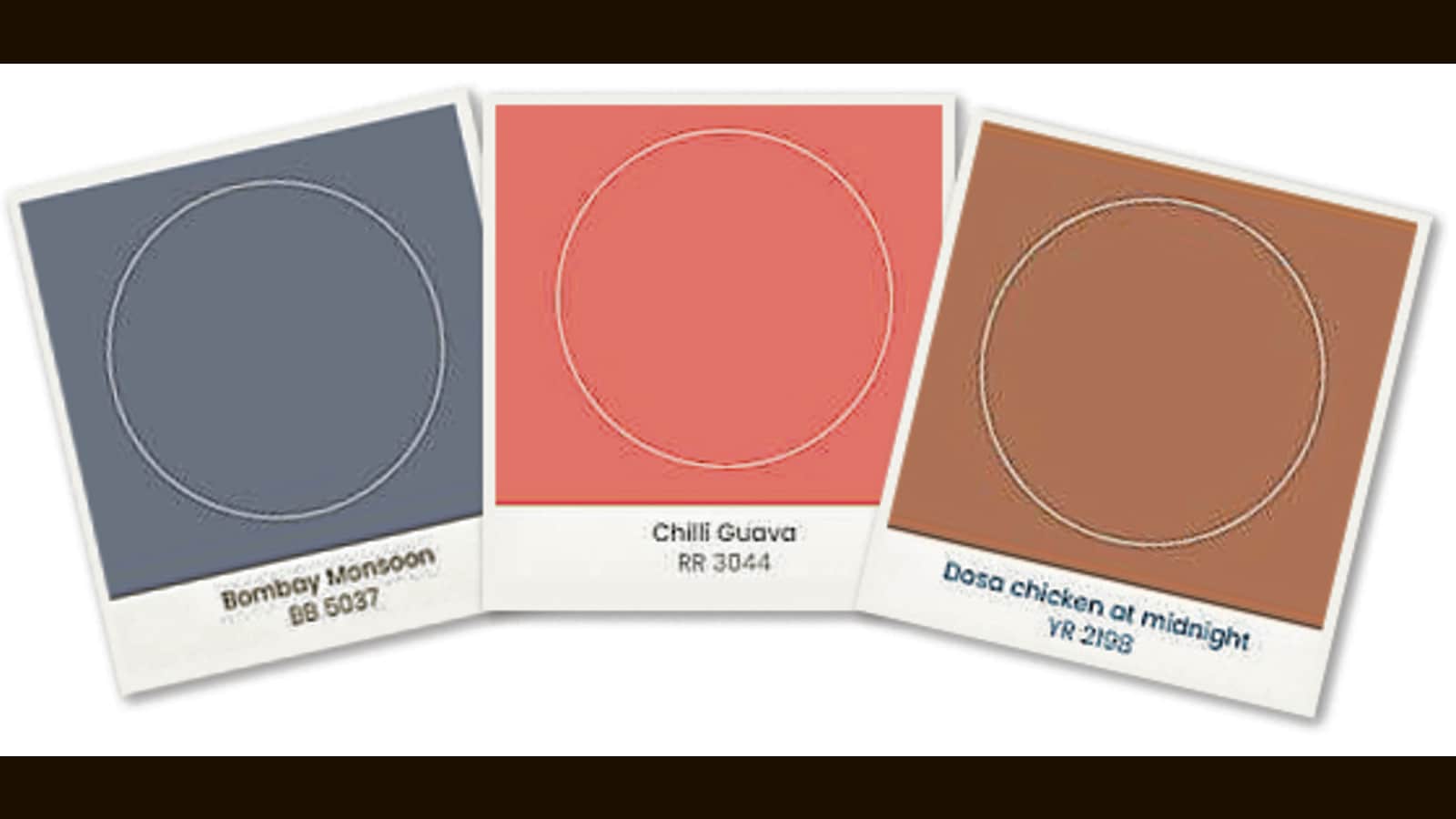
Some thus hint at entire hidden stories: Mehrunnissa’s Saffron, Roses at Manik Mahal (an orange-red), Dosa Chicken at Midnight (a brownish orange, and an ode to Bengaluru).
It was undoubtedly fun, Ganapathi adds, but it could also feel fairly perplexing, particularly with shades that seemed almost identical to the naked eye. As she sat with her spreadsheet of colours and let her instincts guide her, she sometimes had to redo entire rows because names she assigned to one colour seemed to fit another better “only moments later!”
While her clients were encouraging and appreciated her sense of whimsy, there were some tags that did not work. There was a fair amount of discussion about a grey named Tears for Lunch, which didn’t make it to the swatches, she says. laughing. “You most likely wouldn’t like to paint your walls in a colour with that tag. Unless you’re a very morose and melancholic person.”
The colours she thought would be simplest, the reds and pinks (there’s so much to draw on, after all) turned out to be the ones that stumped her. They tended to blend into each other, she says, and she was keen to avoid going the tired way of romantic and feminine tropes. “Pink is also the colour of flesh, after all, and of wounds,” she says.
So, for inspiration, Ganapathi drew on a poem she once read that had stayed with her: Against Pink by the Chinese-American Dara Yen Elerath. “Pink is an unhappy hue, not soothing like cerulean, nor calming like lavender or gray,” a line in the poem goes.
Inspired by Elerath, Ganapathi eventually tapped into the more tactile sides of this colour. One reddish orange, for instance, is called Chilli Guava, after the vivid flesh of that fruit.
“I couldn’t evoke very obvious violence through the names but tried using more diluted feelings of aggression. So there is a warm red called Mogambo Khus Hua, a warm orangish red named Stepped On Kolam, and a bright red called Stop Sign, all of which aren’t the nicest things to encounter.”
Stepped On Kolam, which speaks of “a gentle, forgivable kind of violence”, is perhaps her favourite of them all, Ganapathi says.
Another one close to her heart: Mumbai at Midnight, a shade of electric yellow that calls to mind the halogen lamps of the megalopolis that never sleeps.
“There is such a romance to colours, isn’t there?” she says.
[ad_2]
Source link